Weathervanes Popular With Collectors
While weathervanes are a quintessential sight across the American countryside, these architectural amusements have a far more ancient history. A Greek is credited with inventing the first around 48 B.C., shaping the 8-ft. long structure into the likeness of Triton, the Greek god of the sea.
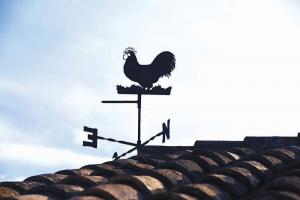
Roosters became a common motif on weathervanes across 9th-century Europe, where they served as a symbol of Christianity on the orders of Pope Leo IV. Weathervanes later became a common sight on Viking ships, where they served as both a status symbol and a navigational tool. In fact, Swedish and Norwegian ships continue to use this ancient technology today.
“Vane” comes from the Old English word “fane,” meaning flag. The key piece of a weathervane is the central pivoting arrow or pointer. The pointer is usually tapered at one end to provide balance and catch even light winds. The larger end of the pointer acts as a scoop that catches the wind. Once the pointer turns, the larger end will find a balance and line up with the source of the wind.
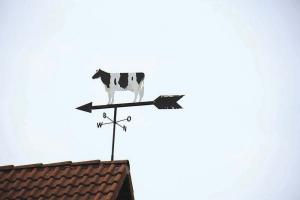
Traditionally, weathervanes are built with a tail to catch the wind and an arrow that points in the direction it’s blowing. Blacksmiths and metalworkers crafted them, and they were a common sight on barns, porches, town halls and carriage houses. Some towns even powered their public clocks with wind. Most large dairy barns in the Midwest built before the start of the 20th century have a weathervane on the roof.
Across America, farmers used weathervanes to gauge shifting weather patterns for both storm avoidance and energy use. The devices helped people predict wind direction and intensity before operating windmills for large-scale projects such as grinding grain or drying corn. Wind-driven sawmills even cut and shaped lumber.
American weathervanes adopted increasingly patriotic designs, such as the Goddess of Liberty and the Federal Eagle. During the Victorian Era, elaborate designs took precedence, while simpler, rural-inspired forms won out by the 1900s. Today, modern weathervanes are made in a variety of shapes and styles.
By the mid-19th century, wind power had become less important as steam and coal began to take its place. The modern world’s abundance of weather-prediction tools has transformed weathervanes from practical instruments into decorative ones.
Even so, famous weathervanes abound across the country. George Washington’s Mount Vernon vane was made of copper and shaped like a dove, complete with an olive branch of peace in its mouth. Likewise, the copper grasshopper decorating the roof of Faneuil Hall in Boston is considered America’s most famous weathervane. These historic artifacts are increasingly collectible and can be found in antique shops and on online auction sites. Some can fetch over half a million, and one sold for $5.84 million to the Executive Vice President of Polo Ralph Lauren.
If you’re lucky enough to own a historic weathervane, keep it safe. These pieces of Americana will always find an appreciative audience.
Click here to download page story appeared in.
Click here to read entire issue
Weathervanes Popular With Collectors
While weathervanes are a quintessential sight across the American countryside, these architectural amusements have a far more ancient history. A Greek is credited with inventing the first around 48 B.C., shaping the 8-ft. long structure into the likeness of Triton, the Greek god of the sea.
Roosters became a common motif on weathervanes across 9th-century Europe, where they served as a symbol of Christianity on the orders of Pope Leo IV. Weathervanes later became a common sight on Viking ships, where they served as both a status symbol and a navigational tool. In fact, Swedish and Norwegian ships continue to use this ancient technology today.
“Vane” comes from the Old English word “fane,” meaning flag. The key piece of a weathervane is the central pivoting arrow or pointer. The pointer is usually tapered at one end to provide balance and catch even light winds. The larger end of the pointer acts as a scoop that catches the wind. Once the pointer turns, the larger end will find a balance and line up with the source of the wind.
Traditionally, weathervanes are built with a tail to catch the wind and an arrow that points in the direction it’s blowing. Blacksmiths and metalworkers crafted them, and they were a common sight on barns, porches, town halls and carriage houses. Some towns even powered their public clocks with wind. Most large dairy barns in the Midwest built before the start of the 20th century have a weathervane on the roof.
Across America, farmers used weathervanes to gauge shifting weather patterns for both storm avoidance and energy use. The devices helped people predict wind direction and intensity before operating windmills for large-scale projects such as grinding grain or drying corn. Wind-driven sawmills even cut and shaped lumber.
American weathervanes adopted increasingly patriotic designs, such as the Goddess of Liberty and the Federal Eagle. During the Victorian Era, elaborate designs took precedence, while simpler, rural-inspired forms won out by the 1900s. Today, modern weathervanes are made in a variety of shapes and styles.
By the mid-19th century, wind power had become less important as steam and coal began to take its place. The modern world’s abundance of weather-prediction tools has transformed weathervanes from practical instruments into decorative ones.
Even so, famous weathervanes abound across the country. George Washington’s Mount Vernon vane was made of copper and shaped like a dove, complete with an olive branch of peace in its mouth. Likewise, the copper grasshopper decorating the roof of Faneuil Hall in Boston is considered America’s most famous weathervane. These historic artifacts are increasingly collectible and can be found in antique shops and on online auction sites. Some can fetch over half a million, and one sold for $5.84 million to the Executive Vice President of Polo Ralph Lauren.
If you’re lucky enough to own a historic weathervane, keep it safe. These pieces of Americana will always find an appreciative audience.
To read the rest of this story, download this issue below or click
here to register with your account number.