2026 - Volume #50, Issue #3, Page #03
[ Sample Stories From This Issue | List of All Stories In This Issue | Print this story
| Read this issue]
Farm-Built Doodlebug Is Small Yet Fast
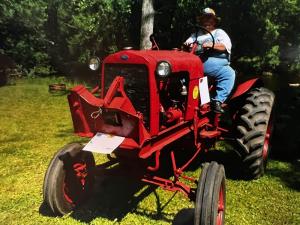 |

He used a Ford Model A radiator, engine, clutch and 3-speed transmission, followed by an REO Speedwagon truck transmission. A Timken bearing worm-drive rear end from the late teens to early twenties came from a truck with hard-rubber tires and wooden spoke rims. It was built by the Timken Bearing Axle Company of Detroit, Mich.
The hood was made from the skin of a Fordson tractor’s gas tank. The front hand-crank winch raised and lowered a snowplow. It was also equipped with a belt-driven governor.
“During the ‘50s and ‘60s, we chopped all our feed for our dairy farm. Our chopper boxes were rear-unloading hook-off boxes that were unloaded into a long hopper belt blower. All our hay and corn silage and straw bedding was transported to our barn and silo with this tractor. We used it in the winters to plow snow and haul manure daily,” says Nathan Larson, Albert’s son.
The two transmissions provide a number of gear speeds. Putting both in reverse puts the tractor into a slow, forward-creeping speed. Putting both transmissions into high gear makes the homemade tractor capable of speeds of 45 mph.
Albert called the tractor the “Mosquito Bomber” after the WWII British Air Force plane, small yet very fast, just like his tractor.
Contact: FARM SHOW Followup, Nathan Larson, Shiocton, Wis.
Click here to download page story appeared in.
Click here to read entire issue
To read the rest of this story, download this issue below or click here to register with your account number.