Rapid Tillage System Delivers Weed Control And More
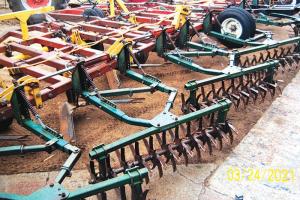 ✖  |
Roger Kuntz has spent nearly 50 years helping growers master their tillage practices. The former head of the Flex-King service department is still at it. He and his son, Adam, travel across Kansas and surrounding states, advising farmers struggling with tillage, particularly those using Flex-King tillage equipment. Central to that is his Rapid Tillage System. He says it kills weeds, reduces soil compaction, and extends equipment life.
“People are going broke with spraying and instead are going back to tillage,” says Kuntz. “The problem is they need information on how to till. We go out with our pickup and tools and fix things, but there’s much that people can do on their own.”
Kuntz developed a guidebook for tillage returnees or those tilling for the first time. It covers virtually all tillage equipment and explains how it works. The guide is free, as is a leveling guide he sends on request.
Kuntz identifies major problems that tillers encounter and ask about. They include uneven depth, ridging, pulling hard, poor weed control, and failure to penetrate hard ground.
He notes that uneven depth has become a greater problem as tillage equipment has increased from one section to as many as 11.
“The axle-to-frame ratio is critical and is adjusted with turnbuckles or anchors to the series cylinders,” he says. “Getting this right allows for going shallow at an even depth. It’s the most complex part of the leveling procedure.”
He notes that ridging is addressed by the exact tilt of the unit.
“It must be nose-up by about two degrees,” says Kuntz. “Choice of blades will have a major effect.”
He explains that pulling hard results from uneven depth and ridging.
“Attachments to the rear of the machine are suspect,” he adds.
According to Kuntz, poor weed control results from failures in uniform depth, tilt, speed and blade choice.
“The most frustrating of all is that the implement will not penetrate hard ground,” says Kuntz. “Usually, the owner has just purchased a blunt, thick and poorly designed blade that’s more of a bulldozer, with a long heel under the blade that makes it a virtual ski in the field.”
To get the most out of tillage equipment, Kuntz’s mantra is go fast, go shallow, go home. To do so, he emphasizes not only leveling but also removing attachments from the rear of the implement.
Going deep only adds to the problem, says Kunz. He suggests it only makes the tractor work harder, adding to maintenance and shortening its working life. At the same time, the extra weight from attachments increases maintenance and the risk of failure of the tillage equipment itself.
When it comes to blades, Kunz recalls the Noble Inlaid Bottom Surface Blade as the best he’s seen. A blunt blade, he adds, crumbles, pushes and ridges the dirt, costing another 25% in horsepower and fuel.
“The only hope for maximum tillage performance is a high-quality, low-cost bottom surface blade,” says Kunz. “It’ll turn into a chrome-like, smooth surface that’ll be sharp and pull easily.”
With attachments removed and the proper blade, Kunz advises that the only remaining factor for maximum speed is depth.
“Deep farming is your enemy,” he says. “Our suggested speed for blade plowing is at least 8 mph. The weed root system’s life support is shattered. It lies bare-root, dead on top of the ground.”
Recognizing that seeing is believing, Kunz suggests that growers try his recommendation of shallow blades first.
“Some have older, smaller units they could modify at minimal cost,” he says. “The alternative is to replace blades and simply lift up attachments. If they like what they see, remove the attachments for good.”
Kunz has developed several tools to help farmers with their tillage. He designed a replacement turnbuckle for Sunflower, Flex-King and Richardson tillage systems. It’s a heavy-duty design with 1 1/2-in. threads that allows sections to be adjusted evenly. He also offers rebuilt and new turnbuckles with 1 1/2-in. threads for Noble units.
He also offers a replacement for floppy tongues on tillage equipment.
“Our Dual Point Rigid Tongue eliminates holding and propping, is durable, and accepts today’s larger drawbar pins,” says Kunz. “Any brand can be converted with the dimension supplied for a two-pin hookup.”
Contact: FARM SHOW Followup, K-Tech, 5251 County Road X, Grainfield, Kan. 67737 (ph 785-673-5560).
Click here to download page story appeared in.
Click here to read entire issue
Rapid Tillage System Delivers Weed Control And More
Roger Kuntz has spent nearly 50 years helping growers master their tillage practices. The former head of the Flex-King service department is still at it. He and his son, Adam, travel across Kansas and surrounding states, advising farmers struggling with tillage, particularly those using Flex-King tillage equipment. Central to that is his Rapid Tillage System. He says it kills weeds, reduces soil compaction, and extends equipment life.
“People are going broke with spraying and instead are going back to tillage,” says Kuntz. “The problem is they need information on how to till. We go out with our pickup and tools and fix things, but there’s much that people can do on their own.”
Kuntz developed a guidebook for tillage returnees or those tilling for the first time. It covers virtually all tillage equipment and explains how it works. The guide is free, as is a leveling guide he sends on request.
Kuntz identifies major problems that tillers encounter and ask about. They include uneven depth, ridging, pulling hard, poor weed control, and failure to penetrate hard ground.
He notes that uneven depth has become a greater problem as tillage equipment has increased from one section to as many as 11.
“The axle-to-frame ratio is critical and is adjusted with turnbuckles or anchors to the series cylinders,” he says. “Getting this right allows for going shallow at an even depth. It’s the most complex part of the leveling procedure.”
He notes that ridging is addressed by the exact tilt of the unit.
“It must be nose-up by about two degrees,” says Kuntz. “Choice of blades will have a major effect.”
He explains that pulling hard results from uneven depth and ridging.
“Attachments to the rear of the machine are suspect,” he adds.
According to Kuntz, poor weed control results from failures in uniform depth, tilt, speed and blade choice.
“The most frustrating of all is that the implement will not penetrate hard ground,” says Kuntz. “Usually, the owner has just purchased a blunt, thick and poorly designed blade that’s more of a bulldozer, with a long heel under the blade that makes it a virtual ski in the field.”
To get the most out of tillage equipment, Kuntz’s mantra is go fast, go shallow, go home. To do so, he emphasizes not only leveling but also removing attachments from the rear of the implement.
Going deep only adds to the problem, says Kunz. He suggests it only makes the tractor work harder, adding to maintenance and shortening its working life. At the same time, the extra weight from attachments increases maintenance and the risk of failure of the tillage equipment itself.
When it comes to blades, Kunz recalls the Noble Inlaid Bottom Surface Blade as the best he’s seen. A blunt blade, he adds, crumbles, pushes and ridges the dirt, costing another 25% in horsepower and fuel.
“The only hope for maximum tillage performance is a high-quality, low-cost bottom surface blade,” says Kunz. “It’ll turn into a chrome-like, smooth surface that’ll be sharp and pull easily.”
With attachments removed and the proper blade, Kunz advises that the only remaining factor for maximum speed is depth.
“Deep farming is your enemy,” he says. “Our suggested speed for blade plowing is at least 8 mph. The weed root system’s life support is shattered. It lies bare-root, dead on top of the ground.”
Recognizing that seeing is believing, Kunz suggests that growers try his recommendation of shallow blades first.
“Some have older, smaller units they could modify at minimal cost,” he says. “The alternative is to replace blades and simply lift up attachments. If they like what they see, remove the attachments for good.”
Kunz has developed several tools to help farmers with their tillage. He designed a replacement turnbuckle for Sunflower, Flex-King and Richardson tillage systems. It’s a heavy-duty design with 1 1/2-in. threads that allows sections to be adjusted evenly. He also offers rebuilt and new turnbuckles with 1 1/2-in. threads for Noble units.
He also offers a replacement for floppy tongues on tillage equipment.
“Our Dual Point Rigid Tongue eliminates holding and propping, is durable, and accepts today’s larger drawbar pins,” says Kunz. “Any brand can be converted with the dimension supplied for a two-pin hookup.”
Contact: FARM SHOW Followup, K-Tech, 5251 County Road X, Grainfield, Kan. 67737 (ph 785-673-5560).
To read the rest of this story, download this issue below or click
here to register with your account number.